On the Road Again Song and Lyrics
| Canned Rut | |
|---|---|
 Performing on September 7, 1979, at the Woodstock Reunion 1979, Parr Meadows, Ridge, New York | |
| Background information | |
| Origin | Los Angeles, California, U.S. |
| Genres |
|
| Years active | 1965–present |
| Labels |
|
| Website | cannedheatmusic |
| Members |
|
| Past members | See Listing of Canned Heat band members |
Canned Estrus is an American blues rock band that was formed in Los Angeles in 1965. The grouping has been noted for its efforts to promote interest in blues music and its original artists. It was launched by two blues enthusiasts Alan Wilson and Bob Hite, who took the name from Tommy Johnson's 1928 "Canned Heat Blues", a song about an alcoholic who had badly turned to drinking Sterno, generically called "canned estrus", from the original 1914 production name Sterno Canned Heat.[one] After appearances at the Monterey and Woodstock festivals at the end of the 1960s, the band acquired worldwide fame with a lineup consisting of Hite (vocals), Wilson (guitar, harmonica and vocals), Henry Vestine and later on Harvey Mandel (atomic number 82 guitar), Larry Taylor (bass), and Adolfo de la Parra (drums).
The music and mental attitude of Canned Oestrus attracted a large following and established the band equally 1 of the pop acts of the hippie era. Canned Heat appeared at about major musical events at the end of the 1960s, performing blues standards along with their own textile and occasionally indulging in lengthy 'psychedelic' solos. Two of their songs — "Going Up the Country" and "On the Route Again" — became international hits. "Going Up the Country" was a remake of the Henry Thomas song "Balderdash Doze Blues", recorded in Louisville, Kentucky, in 1927. "On the Road Again" was a remake of the 1953 Floyd Jones song of the same name, which is reportedly based on the Tommy Johnson vocal "Big Route Blues", recorded in 1928.
Since the early on 1970s, numerous personnel changes take occurred. For much of the 1990s and 2000s and following Larry Taylor'southward expiry in 2019,[ii] de la Parra has been the only fellow member from the band'due south 1960s lineup. He wrote a book about the band's career, titled Living the Blues.[iii] Mandel, Walter Trout and Junior Watson are among the guitarists who gained fame for playing in subsequently editions of the band.
History [edit]
Origins and early on lineups [edit]
Canned Heat was started within the community of dejection collectors. Bob Hite had been trading blues records since his early teens, and his business firm in wealthy Topanga Coulee was a meeting identify for people interested in music. In 1965 some blues devotees there decided to form a jug band and started rehearsals. The initial configuration comprised Hite as vocalist, Alan Wilson on clogging guitar, Mike Perlowin on lead guitar, Stu Brotman on bass and Keith Sawyer on drums. Perlowin and Sawyer dropped out within a few days, so guitarist Kenny Edwards (a friend of Wilson's) stepped in to supersede Perlowin, and Ron Holmes agreed to sit down in on drums until they could discover a permanent drummer.
Another of Hite's friends, Henry Vestine (who had been expelled from Frank Zappa's Mothers of Invention for smoking pot),[four] asked if he could join the band and was accustomed, while Edwards was kept on temporarily. Shortly Edwards departed (he went on to form the Stone Poneys with Bobby Kimmel and Linda Ronstadt), and at the same time Frank Melt came in to supplant Holmes as their permanent drummer. Melt already had substantial professional experience, having performed with such jazz luminaries as bassist Charlie Haden, trumpeter Chet Bakery, and pianist Elmo Hope, and had likewise collaborated with blackness soul/pop artists such as Shirley Ellis and Dobie Gray.
Producer Johnny Otis recorded the band's outset (unreleased) album in 1966 with the ensemble of Hite, Wilson, Cook, Vestine, and Brotman; but the record was not actually released until 1970 when it appeared as Vintage Heat, released by Janus Records. Otis ran the lath for a dozen tracks, including ii versions of "Rollin' and Tumblin'" (with and without harmonica), "Spoonful" by Willie Dixon, and "Louise" by John Lee Hooker all from his studio off of Vine Street in Los Angeles. Over a summer hiatus in 1966 Stuart Brotman finer left Canned Heat subsequently he had signed a contract for a long date in Fresno with an Armenian abdomen-trip the light fantastic revue. Canned Heat had contacted Brotman, touting a recording contract which had to be signed the adjacent day, simply Brotman was unable to make the signing on short detect. Brotman would go on to join the world-music ring Kaleidoscope with David Lindley, replacing Chris Darrow. Replacing Brotman in Canned Heat was Mark Andes, who lasted only a couple of months before he returned to his former colleagues in the Reddish Roosters, who adopted the new name Spirits Rebellious, later shortened to Spirit.
Afterward joining upwardly with managers Skip Taylor and John Hartmann, Canned Heat finally found a permanent bassist in Larry Taylor, who joined in March 1967. He was a erstwhile fellow member of The Moondogs and the brother of Ventures' drummer, Mel Taylor, and already had experience backing Jerry Lee Lewis and Chuck Berry in concert, and recording studio sessions for The Monkees.[5]
In this format (Hite, Wilson, Vestine, Taylor, Cook) the band started recording in April 1967 for Liberty Records with Calvin Carter, who had been the head of A&R for Vee-Jay Records and had recorded such bluesmen as Jimmy Reed, John Lee Hooker.[six] They recorded "Rollin' and Tumblin'", backed with "Bullfrog Blues", and this became Canned Estrus's first single. The starting time official album, Canned Oestrus, was released three months later in July 1967. All tracks were re-workings of older blues songs. The Los Angeles Costless Printing reported: "This grouping has information technology! They should practise very well, both alive and with their recordings." Canned Heat fared reasonably well commercially, reaching #76 on the Billboard chart.
Ascension to fame and formation of the classic lineup [edit]
The first big live advent of Canned Oestrus was at the Monterey Pop Festival on June 17, 1967. A picture of the band taken at the performance was featured on the encompass of Down Trounce where an article complimented their playing: "Technically, Vestine and Wilson are quite possibly the best two-guitar team in the world and Wilson has certainly get our finest white blues harmonica man. Together with powerhouse vocalist Bob Hite, they performed the state and Chicago blues idiom of the 1950s and then skillfully and naturally that the question of which race the music belongs to becomes totally irrelevant."[7] D.A. Pennebaker'due south documentary captured their rendition of "Rollin and Tumblin" and two other songs from the ready, "Bullfrog Blues" and "Dust My Broom", constitute a identify subsequently in a boxed CD set in 1992. Canned Heat is also included on an album chosen Early LA.
Canned Heat likewise began to garner their notoriety every bit "the bad boys of rock" for existence jailed in Denver, Colorado after a constabulary informant provided plenty show for their abort for drugs (an incident recalled in their song "My Crime"). Band director Skip Taylor was forced to obtain the $x,000 bail by selling off Canned Heat'south publishing rights to Freedom Records president Al Bennett.[viii]
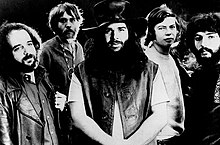
1970 photo of the classic Canned Heat lineup.
After the Denver incident, Frank Cook was replaced with de la Parra, who had been playing the drums in Bluesberry Jam (the ring which evolved into Pacific Gas & Electric). Every bit an official member of Canned Heat, de la Parra played his start gig on Dec one, 1967, sharing top billing with the Doors at the Long Beach Auditorium.[9] This began what de la Parra refers to equally the classic and maybe best known Canned Heat lineup, which recorded some of the ring's most famous and well-regarded songs. During this "classic" menstruum, Skip Taylor and John Hartmann introduced the apply of band fellow member nicknames:
- Bob "The Bear" Hite
- Alan "Bullheaded Owl" Wilson
- Henry "Sunflower" Vestine (and later Harvey "The Snake" Mandel)
- Larry "The Mole" Taylor
- Adolfo "Fito" de la Parra
Their 2nd released anthology, Boogie with Canned Heat, included "On the Route Again", an updated version of a 1950s composition by Floyd Jones. "On the Road Over again" became the band'southward break-out song and was a worldwide success, becoming a number one hitting in nearly markets and finally put a blues song on the top charts.[x] The album also included a twelve-infinitesimal version of "Fried Hockey Boogie", (credited to Larry Taylor, but rather evidently derived from John Lee Hooker'due south "Boogie Chillen" riff) allowed each member to stretch out on his instrument while establishing them with hippie ballroom audiences across America every bit the "kings of the boogie". Hite's "Amphetamine Annie" (a "speed kills" tune inspired by the drug abuse of an acquaintance and reminiscent of Albert King's "The Hunter"), became one of their most enduring songs and one of the first "anti-drug" songs of the decade. Although not featured on the album'south artwork, this was the get-go Canned Heat album to take featured drummer de la Parra.
With this success Taylor, Hartmann and new associate Gary Essert leased a Hollywood club they named the Kaleidoscope on Sunset Boulevard due east of Vine in which Canned Oestrus essentially became the house ring; hosting others such as Jefferson Airplane, Grateful Dead, Buffalo Springfield and Sly and the Family Rock.[11] Also in 1968, afterward playing earlier 80,000 at the outset annual Newport Pop Festival in September, Canned Heat left for their outset European tour. It entailed a month of concert performances and media engagements that included television appearances on the British show Top of the Pops. They also appeared on the German plan Beat Club, where they lip-synched "On the Road Once again" as it rose to number one in both countries and in practically all of Europe.[12]
"Going Upwards the Country" and Woodstock [edit]
In Oct the band released their 3rd album, Living the Blues, which included "Going Up the Country", their all-time-known vocal. Wilson's incarnation of Henry Thomas' "Bull-Doze Blues" was almost a note-for-note re-create of the original, including Thomas' instrumental intermission on the "quills" (pan-pipes) which Jim Horn duplicated on flute. Wilson rewrote the lyrics with a simple message that caught the "back-to-nature" attitude of the late 1960s. The vocal was a hitting in numerous countries around the world (#eleven on the U.S. national chart) and would go on to get the unofficial theme song of the Woodstock Festival equally captured in Michael Wadleigh's 1970 documentary. The anthology also included a 19-minute experimental track "Parthenogenesis", which was a nine-role sound collage of blues, ragas, jaw-harp sounds, guitar distortion and other electronic effects; all pulled together under the management of manager/producer, Skip Taylor. Longer even so is "Refried Boogie", clocking in at over twoscore minutes, recorded live at the Kaleidoscope.
Also recorded live at the Kaleidoscope around this fourth dimension was the album which would notice afterwards 1971 release with the deceptive title, Live At Topanga Corral (afterwards renamed Live at the Kaleidoscope), under Wand Records because Liberty Records did not want to release a alive album at the time and director Skip Taylor did non want a lawsuit.[13] The band would terminate 1968 in a large mode at a New Twelvemonth'due south show at the Shrine Auditorium, in Los Angeles, with Bob Hite riding a painted purple dayglo elephant to the stage.[14]
In July 1969, simply prior to Woodstock, Hallelujah, their quaternary anthology was released. The Melody Maker wrote: "While less ambitious than some of their work, this is nonetheless an first-class blues-based album and they remain the most convincing of the white electric blues groups." The anthology independent mainly original compositions with lyrics relating to the band such as Wilson's "Time Was" and a few re-worked covers like "Sic 'em Pigs" (Bukka White'southward "Sic 'em Dogs") and the original "Canned Heat" past Tommy Johnson.
Within days of the album's release, Vestine left the group afterwards an on-stage accident up at the Fillmore West between himself and Larry Taylor. The next night afterward Mike Bloomfield and Harvey Mandel jammed with Canned Estrus, both were offered Vestine's spot in the band's line-upwardly and Mandel accustomed.[fifteen] The new lineup played two dates at the Fillmore before actualization at Woodstock in mid-August.
Arriving via helicopter at Woodstock, Canned Heat played their most famous set on the 2nd twenty-four hour period of the festival at sunset. The set included "Going Upwardly the State" which became the title runway in the documentary, even though the band'due south performance was not shown. The song was included in the get-go (triple) Woodstock album; while the 2d anthology, Woodstock 2, contained "Woodstock Boogie". The expanded 25th Ceremony Collection added "Leaving This Town" to the band'south collection of Woodstock performances and "A Change Is Gonna Come" was included on the managing director'southward cut of the documentary picture show; leaving only "Let's Piece of work Together" to exist released.[sixteen]
Before their European tour in early on 1970, the ring recorded Hereafter Blues, an album containing five original compositions and iii covers. "Permit'south Work Together", a Wilbert Harrison vocal, was the single called for release in Europe to coincide with the tour. At the band's insistence the U.Due south. release was delayed in order to offer the author's version a chance in the marketplace first.[17] Canned Heat had a large striking with "Allow's Work Together" and was the band'due south only peak ten hit to characteristic the vocals of Bob "The Bear" Hite. The anthology featured piano by Dr. John and an atypical jump blues fashion also. Some controversy was sparked past the moon landing/Iwo Jima album cover and the upside downward American flag. The upside-down flag was Wilson'southward idea and was a response to his love of nature, growing environmentalism and business organization that humankind would soon be polluting the moon likewise equally the Earth (every bit reflected in his song "Poor Moon").[18]
Material from their 1970 European tour provided the tracks for, Canned Heat '70 Concert Alive in Europe, later retitled Live in Europe. Information technology was a live anthology that combined tracks from different shows throughout the bout, but was put together in such a way as to resemble one continuous concert for the listener. Although the anthology garnered some critical acclaim and did well in the UK (peaking at #fifteen), it had just limited commercial success in the U.S.; Returning from Europe in May 1970, an exhausted Larry Taylor left the band to join John Mayall (who had moved to Laurel Canyon, California) and was followed past Mandel.
Hooker 'n Heat and the death of Wilson [edit]
With Taylor and Mandel gone, Vestine returned on guitar, accompanied by bassist Antonio de la Barreda who had played with de la Parra for five years in United mexican states City and was previously a member of the groups Jerome and Sam & the Goodtimers.
This lineup went into the studio to tape with John Lee Hooker the tracks that would yield the double album, Hooker 'n Rut. The band had originally met Hooker at the aerodrome in Portland, Oregon, and discovered they were fans of each other's work. Hooker and Canned Heat became skilful friends and Hooker had stated that Wilson was "the greatest harmonica player e'er".[19] The planned format for the sessions called for Hooker to perform a few songs past himself, followed by some duets with Wilson playing piano or guitar. The residuum of the album featured Hooker with some backing by the grouping (sans Bob Hite, who co-produced the album along with Skip Taylor). The album was finished afterwards Wilson's passing and became the starting time album in Hooker's career to make the charts, topping out at #73 in February 1971. Hooker 'n Heat would unite again in 1978 and record a live album at the Play a trick on Venice Theatre in Los Angeles, released in 1981 every bit, Hooker 'n Heat, Alive at the Flim-flam Venice Theatre, under Rhino Records. As well in 1989, Canned Oestrus (and many others) guested on John Lee Hooker'south album The Healer.
Shortly after the original Hooker 'north Estrus sessions, Wilson, who had always suffered from depression, was said by some to have attempted suicide by driving his van off the road near Hite'southward dwelling in Topanga Canyon. Unlike other members of the band, Wilson did non have much success with women and was securely upset and frustrated past this. His depression also worsened over time.[20] On September 3, 1970, only before leaving for a festival in Berlin, the band learned of Wilson's death by barbiturate overdose; his body was plant on a hillside behind Hite's home. De la Parra and other members of the band believed that his decease was a suicide. Wilson died at the age of 27, but weeks earlier Jimi Hendrix, and then Janis Joplin, died at the same age.[21]
Historical Figures, New Historic period and Human Condition line-ups [edit]
Joel Scott Hill, who had played with the Strangers and the Joel Scott Hill Trio, was recruited to fill the void left by Wilson'south death. The band notwithstanding had a touring contract for September, also every bit upcoming studio dates. That fall they toured Australia and Europe; including a bear witness played in Baarn, Netherlands, for the VPRO television program Piknik and the following summer they appeared at the Turku Festival in Finland. These performances were recorded, merely the recordings were not released until much later, with the albums Alive at Turku Stone Festival in 1995 and Under the Dutch Skies 1970–74 in 2007 (which encompassed three separate tours). At the end of 1971 a new studio album, Historical Figures and Ancient Heads, was released. The album included Hite'southward vocal duet with Picayune Richard on "Rockin' with the Male monarch", written by Skip Taylor and featuring the guitar playing of both Vestine and Joel Scott Hill.
This lineup of Hite, Vestine, Scott Hill, de la Barreda and de la Parra did not terminal, equally the band was in disarray; Scott Hill and de la Barreda's attitudes were not plumbing fixtures in with the rest of the ring, and drummer de la Parra decided to telephone call it quits. He was talked out of it by Hite, and information technology was Scott Hill and de la Barreda who left the ring instead.[22]
New additions to the group were James Shane on rhythm guitar and vocals, Ed Beyer on keyboards, and Richard Hite (Bob Hite'southward brother) on bass. This lineup recorded what was the ring'south concluding album for Liberty/United Artists Records, The New Age, released in 1973. This album featured the popular biker-themed canticle "The Harley-Davidson Blues", written by James Shane. The era of the late 1960s was changing, but still the band embarked on another European tour, during which they recorded a session with Memphis Slim in Paris, France for the anthology Memphis Estrus. They as well recorded with Clarence "Gatemouth" Brown, while notwithstanding in Paris, for the album Gates on the Heat (both were released by Bluish Star Records).[23] Footage from this era can be seen on the DVD Canned Heat Live at Montreux, released in 2004.
Met with hard times, de la Parra writes that the band resorted to importing drugs from Mexico to make ends run across between shows.[24] Over $30,000 in debt, manager Skip Taylor advised the band to sign away their future royalties to their previous Liberty/United Artists material and bound to Atlantic Records. After a bad introduction to Atlantic Records, which included a ball between Hite and Vestine over a vending machine, the band released the anthology One More River to Cross in 1973. Produced past Roger Hawkins and Barry Beckett, this album had a different sound and featured the Muscle Shoals Horns.[25]
On a subsequent promotional bout of Europe, this new "horn band" sound included the talents of Clifford Solomon and Jock Ellis. Absent from Canned Heat at this time, subsequently growing ever more distant, was longtime director Skip Taylor, who had left subsequently the band joined Atlantic.[26] Atlantic producer Tom Dowd tried to get one more than anthology out of Canned Heat, despite their drug use and heavy drinking; they ultimately recorded an album'south worth of material at Criteria Studios in Miami, Florida during 1974 (featuring some collaboration with erstwhile member Mandel), just Atlantic ended its human relationship with Canned Oestrus earlier information technology could be released. The masters for the majority of the material, which had been kept at Skip Taylor's house, were destroyed in a fire, and what material was rescued by de la Parra was finally restored and issued decades later, in 1997, titled The Ties That Bind.[27] [28]
Soon thereafter, new managing director Howard Wolf ready up the struggling band with a gig at California's Mammoth Ski Resort. Bob Hite, in a foul rage, went off on the oversupply, to the disapproval of Vestine, James Shane and Ed Beyer, who quit the band as a event.[29]
Taking the identify of those who departed were pianist Gene Taylor and guitarist Chris Morgan, who both joined in late 1974. Taylor departed in 1976 in response to an argument during a bout of Germany, and after a brief fill-in past Stan Webb (of Chicken Shack), Mark Skyer came in as the new guitar player. In the meantime the band had worked out a deal with Takoma Records, and this "Human Condition/Takoma" lineup recorded the 1977 album Human being Status. Despite the appearance of the Chambers Brothers on the album, it was met with very little success, largely because of the growing popularity of disco music in the tardily 70s.[27] Before long, more than arguments ensued, and Mark Skyer, Chris Morgan and Richard Hite all quit the ring in 1977. The Conduct promptly hired a new bass actor, Richard Exley, after befriending him on bout and watching his operation with the band Montana. Becoming fast friends with Hite, Exley toured the residuum of the year with the band and collaborated with Hite on many of the arrangements during their 1976 Texas Bicentennial Comeback Tour. Exley then quit the ring afterward an statement over Hite'due south excessive drinking and drug use on stage. Frustrated and fed up, Exley joined the Texas Heartbreakers at the finish of that year but returned periodically to make full in equally a favor to Hite while the band struggled to find permanent members amidst heavy drinking and drug utilise. Exley remarked about his time with the band, "No one always remembers the bass player ...". This effectively reduced the ring's members to simply Hite and de la Parra.[xxx]
Burger Brothers revival and the decease of Bob Hite [edit]
The popularity of the blues genre rose in the late 1970s and early 1980s with the release of the musical-comedy motion picture The Dejection Brothers (1980), starring Dan Aykroyd and John Belushi. During this time, de la Parra had bought into the partnership of an E Hollywood recording studio at which he was again working with onetime bandmate Larry "The Mole" Taylor. Taylor had been associating with virtuoso guitar player Mike "Hollywood Fats" Isle of mann and virtuoso piano player Ronnie Barron and before long Taylor, Barron and Hollywood Fats were in the ring. This version referred to past Hite and Mann as the "Burger Brothers" lineup, was soon joined by bullheaded pianoforte role player Jay Spell, equally Ronnie Barron walked out on the band after a accident-up between himself and Taylor.[31]
The Burger Brothers played the tenth ceremony of Woodstock at Parr Meadows in 1979. A recording of the performance eventually surfaced through King Beige Flower 60 minutes's Barry Ehrmann as, Canned Heat In Concert, in 1995 (de la Parra considers this to be Canned Heat's best recorded live anthology).[32] Another recording made around this time was for Cream Records, who desired a more R&B-style sound than what Canned Heat was currently offering. This upset Hollywood Fats and Mike Halby was brought in to finish the projection; which would non find commercial release until 1981 when quondam ring member Tony de la Barreda put it out under RCA as a tribute album called, In Retention Of Bob "The Behave" Hite 1943-1981—"Don't Forget To Boogie". Later on a falling out with de la Parra and Hite, Taylor and Mann were increasingly unhappy with the musical direction of the band and eventually left to focus more attention on their Hollywood Fats Band. Nevertheless, Jay Spell was yet on board and brought in bass player Jon Lamb; Mike Halby was now a full-time fellow member and long-time guitarist Vestine one time again made his return to the band, with The Behave and de la Parra as its leaders.[33]
No longer managed by Howard Wolf, Eddie Haddad set the band up touring military machine bases across the U.S., Europe and Japan not-terminate. Returning with piddling pay after the difficult tour, Jay Spell quit the ring. Jon Lamb stayed on for 1 more than tour in the south and just before Christmas 1980 (and lacking the outlaw roots of the others), he too quit the band; but past then even The Bear was starting to lose it. He had attempted to give it another effort by hiring a large enthusiastic biker with the moniker "The Push" as their managing director; hoping that the band'due south popularity with the biker customs would give them renewed energy.[34] With new bass player Ernie Rodriguez joining the ranks, Canned Heat recorded the 1981 album, Kings of the Boogie, the final anthology to characteristic Hite on a few of the tracks.
On Apr 5, 1981, having collapsed from a heroin overdose during a show at the Palomino in Los Angeles, Bob Hite was later found dead in de la Parra'due south Mar Vista dwelling house at the age of 38.[35]
Later history and the death of Vestine [edit]
The death of frontman Bob "The Behave" Hite was a devastating accident that most idea would stop the career of Canned Heat; even so de la Parra kept the ring live and would lead it back into prosperity over the next few decades. An Australian tour had been set up before The Carry'south death and harmonica player Rick Kellogg had joined to terminate off the Kings of the Boogie album. This incarnation of Canned Heat without Bob Hite was nicknamed the "Mouth Band" by Vestine and was a huge hit in Australia, especially with the biker oversupply.[36] Under the management of "The Push", the band toured the States playing biker bars and began piece of work on a video known as "The Boogie Assault", starring Canned Oestrus and diverse members of the San Francisco chapter of the Hells Angels.
As production for "The Push button's" video dragged on, a drunken Vestine got into a brawl with Ernie Rodriguez and was once once more out of the band; this time replaced by guitarist Walter Trout.[37] After a bout with John Mayall, every bit the product for "The Boogie Set on" continued, de la Parra was forced to fire "The Push" equally the band's managing director; but did eventually cease the video and a alive lbum of the aforementioned name recorded in Australia in 1982 (too re-released as Live In Australia and Live In Oz). This version of Canned Heat would also presently dissolve with a dispute between Mike Halby and de la Parra after the recording of the Heat Brothers '84 EP.
During the 1980s the interest in the type of music played by Canned Oestrus was revived and, despite the past tragedies and permanent instability, the band appeared to be revitalized. In 1985, Trout had left to join John Mayall's Bluesbreakers, and then Vestine was once over again back in the band and he brought with him new musical talent from Oregon in James Thornbury (slide guitar and lead vocals) and Skip Jones (bass). They were dubbed the "Nuts and Berries" band by de la Parra, due to their love of organic food. It was not long earlier former members Larry Taylor (replacing Jones) and Ronnie Barron returned to round out the group. Versions of this lineup would record the alive album, Boogie Upwardly The Country, in Kassel, Germany, in 1987 and also appear on the Blues Festival Alive in Bonn '87 Vol 2 compilation. Barron, just as before did not last long in this lineup, nor did Vestine, who was once once more ousted from the band due to force per unit area from Larry Taylor. Replacing Vestine on lead guitar was Junior Watson; his manner emulated Hollywood Fats (who died in late 1986) and was perfectly suited for the ring as witnessed by the well-regarded album, Reheated. Unfortunately, the album was released just in Deutschland in 1988 due to disagreements with the Chameleon Music Grouping Record label.[38] In 1990, the "Would-Be" lineup of James T, Taylor, Watson and de la Parra also recorded a sequel live album in Australia entitled Burnin' Live.
The lineup dissolved in the early 1990s as Junior Watson went his own way and Mandel came back into the fold, bringing along Ron Shumake on bass to accept some of the load off of Larry Taylor. Mandel, however, left the band later on a few tours, then female person vocalist and guitarist Becky Barksdale was brought in for a tour of French republic, Federal republic of germany and Hawaii; merely lasted no longer. Smokey Hormel was also considered, just only played i gig before friction between de la Parra and Larry Taylor acquired Taylor to bitterly go his separate manner with Hormel in tow.[39]
The revolving door that was Canned Estrus continued equally Vestine and Watson made their returns to the lineup as the "Heavy Artillery" ring. Several former members including Mandel, Barron and Taylor joined up in de la Parra's effort for the album, Internal Combustion, which was released in 1994, but saw only express release due to the returning manager Skip Taylor's falling out with Red River Records. In 1995, James Thornbury left the band with no hard feelings after 10 years of service to live the married life in New South Wales, Australia and new forepart-man Robert Lucas came in to accept his identify. Mandel returned and Shumake left the band in 1996, and later on the position of bassist was taken temporarily by Mark "Pocket" Goldberg,[forty] Greg Kage took the reins as the bass player, and later a reconciliation with Larry Taylor the ring released, Canned Heat Blues Band, in 1996. On October 20, 1997, a tired and cancer stricken Vestine died in Paris, France following the final gig of a European tour.[41] Taylor and Watson subsequently left the band.
Canned Heat in the 2000s and 2010s [edit]


Canned Heat's popularity has endured in some European countries and Australia. In Belgium they accept a particularly devoted following thanks in groovy role to Walter de Paduwa, a.m.a. Dr. Boogie, considered by the band every bit their "official historian".[42] He has assisted de la Parra in compiling and producing, The Boogie House Tapes Vol. 1 in 2000, The Boogie Firm Tapes Vol. ii in 2004, and Dr. Boogie Presents Rarities from the Bob Hite Vaults in 2008; all collected from unreleased and rare Canned Estrus recordings. Dr. Boogie's weekly Sunday evening radio show on Radio Classic 21,[43] has for over a decade invariably started with a Canned Oestrus song.
Canned Rut's recent studio albums include Boogie 2000 (1999), and Friends In The Can (2003), which features diverse guests, including John Lee Hooker, Taj Mahal, Trout, Corey Stevens, Roy Rogers, Mandel, Larry Taylor and Vestine. Eric Clapton and Dr. John made guest appearances on the Christmas Album (2007). In July 2007, a documentary, Boogie with Canned Heat: The Canned Heat Story, was released, as was a biography of Wilson, Bullheaded Owl Dejection, by author Rebecca Davis Winters.
By 2000, Robert Lucas had departed and the line-up was completed by Dallas Hodge (vocals, guitar),[44] John Paulus (guitar) and Stanley "Baron" Behrens (harmonica, saxophone, flute). Lucas returned to Canned Heat in late 2005 but left again in the fall of 2008. He died, age 46, on Nov 23, 2008, at a friend's home in Long Beach, California; the cause was an credible drug overdose.[45] [46] Other more than contempo deaths of band members included Bob Hite's brother, bassist Richard Hite, who died at age 50 on September 22, 2001, due to complications from cancer. Also, onetime bassist Antonio de la Barreda died of a heart attack on February 17, 2009.
From tardily 2008 to the Jump of 2010 the lineup included Dale Spalding (guitar, harmonica and vocals), Barry Levenson (lead guitar), Greg Kage (bass), and archetype lineup hold-over and band leader de la Parra on drums. Mandel and Larry Taylor toured with Canned Heat during the summer of 2009 on the Heroes of Woodstock Tour to gloat the 40th ceremony of Woodstock.
In 2010, Taylor and Mandel officially replaced Kage and Levenson, and as of 2012, this lineup (de la Parra, Taylor, Mandel, and Spalding) connected to tour regularly.
In October 2012, during a festival tour in Kingdom of spain, France and Switzerland, Randy Resnick was chosen to replace Harvey Mandel who had to quit the tour due to health issues. Resnick played two dates, Oct iv and 5, but had to return domicile for prior commitments. Adolfo de la Parra was able to go John Paulus to fly in from Portland to finish the tour.
On September seven, 2013 John Paulus once again substituted for Harvey Mandel at The Southern Maryland Dejection Festival. In 2014 he officially replaced Mandel.
On August 19, 2019 longtime bass guitarist Larry Taylor died afterward a twelve-year battle with cancer.[47] Drummer Frank Cook died on July 9, 2021, aged 79.[48]
The current line-upward of Canned Rut features none of the original or classic-era members of the ring other than Adolfo "Fito" de la Parra on drums.
Collaborations [edit]
Canned Oestrus have collaborated with many blues artists, recording and helping them to regain some notoriety. Notable names include:
- John Lee Hooker — In May 1970, Canned Heat backed John Lee Hooker on the album Hooker 'n Heat released in early 1971. In 1978 a joint operation was recorded live and released as Hooker 'n Heat, alive at the Play tricks Venice Theatre (1981). In 1989 Canned Rut (and many others) guested on John Lee Hooker'south album The Healer.
- Sunnyland Slim — In the spring of 1968, Wilson, Bob Hite, and de la Parra took a cab whose driver turned out to be Sunnyland Slim. Wilson and Hite convinced him to go in the studio over again and cut an album for a sublabel of Freedom Records. The anthology, Slim'due south Got His Matter Goin' On featured tracks with Slim fronting Canned Oestrus and Hite acted as co-producer. Slim thanked them by playing the piano on "Turpentine Moan" for the album Boogie with Canned Heat.
- Memphis Slim — In Paris, on September 18, 1970, Canned Estrus went into the studio at the request of French music producer Phillipe Rault to tape with Memphis Slim. Iii years later and after an overdubbing session with the Memphis Horns of Stax Records fame, Memphis Estrus was finally released on the French label, Barclay (and was re-released in 2006 on Sunnyside Recordings).
- Clarence "Gatemouth" Brown — In 1973, Canned Rut went again to France to tape for Rault, this time with Clarence "Gatemouth" Chocolate-brown. The sessions did non piece of work out as planned, merely the album was released as Gate'due south on the Oestrus and another runway appeared in 1975 on his album Down Southward in the Bayou Country. Later they joined him for a gear up at the Montreux Jazz Festival. A DVD of the performance was released.
- Javier Batiz — During the summer of 1969, de La Parra arranged in Los Angeles a recording session for Mexican R&B star Javier Batiz, with whom he had played earlier moving north and joining Canned Heat. His bandmate Larry Taylor took part in the project and also 3 musicians who in later years would perform with the ring, two as members — Tony de la Barreda (bass), Ernest Lane (piano) and Clifford Solomon (saxophone). The recording was released some xxx years later as The Usa Sessions.
- Albert Collins — In early 1969, Canned Oestrus met Collins after a gig and advised him to motility to Los Angeles in guild to boost his career; there they establish him an agent and introduced him to executives for United Artists (UA). In appreciation, Collins' first tape title for UA became Dearest Tin Be Found Anywhere, taken from the lyrics of "Fried Hockey Boogie".
- Henry Vestine — A recording project from 1981 has been released more than xx years later under Vestine's proper name as I Used To Be Mad (but Now I am Half Crazy). The musicians on the album are the Canned Rut members at that time: Vestine (guitar), Mike Halby (vocals, guitar), Ernie Rodrigues (vocals, bass), Ricky Kellogg (vocals, harmonica) and de La Parra (drums).
- De la Parra and Walter de Paduwa, a.k.a. Dr. Boogie, have compiled an album of dejection selected from Bob Hite'south collection Rarities from the Bob Hite Vault, Sub Rosa SRV 271. Included are tracks by a dozen artists such as Pete Johnson, Johnny Otis, Clarence Dark-brown, Otis Rush, Etta James and Elmore James.[49]
- Naftalina — In 1983, Adolfo de la Parra, forth with some old friends and beau Mexican rock groups he played with in the 1960s, such every bit Los Sparks, Los Hooligans and Los Sinners, played the starting time album of Naftalina, covers of stone n coil 1950s — 1960s, with versions total of black sense of humour and sarcasm involved: Tony de la Barreda (bass and product), Federico Arana (guitar and lyrics), Eduardo Toral (piano), Baltasar Mena (vocals), Renato López (vocals), Angel Miranda (drums), Freddy Armstrong (guitar), Guillermo Briseno (piano) and Adolfo de la Parra (drums).
Personnel [edit]
Current members [edit]
- Adolfo de la Parra — drums, vocals (1967–present) [l] [51]
- John Paulus — guitar (2000–2006, 2013, 2014–present)
- Dale Wesley Spalding — guitar, harmonica, bass, vocals (2008–present)
- Rick Reed — bass (2019–present)
Discography [edit]
See also [edit]
- List of bands from Los Angeles
References [edit]
- ^ [1] [ dead link ]
- ^ "Canned Heat Bassist Larry Taylor Dies at 77". Billboard . Retrieved 2019-08-21 .
- ^ Fito De La Parra, Living the Blues.(2000).
- ^ Fito De La Parra, Living the Blues. Canned Heat'south Story of Music, Drugs, Death, Sex and Survival, 2000, p. 66. ISBN 0-9676449-0-9.
- ^ Fito De La Parra, Living the Dejection. Canned Rut's Story of Music, Drugs, Death, Sex and Survival, 2000, p. 112. ISBN 0-9676449-0-9.
- ^ "Billboard". Books.google.co.united kingdom. 1967-07-08. p. 12. Retrieved 2016-05-24 .
- ^ Down Crush, August 10th, 1967.
- ^ Fito De La Parra, Living the Blues. Canned Heat's Story of Music, Drugs, Death, Sex and Survival, 2000, pp. 68-71. ISBN 0-9676449-0-ix.
- ^ Fito De La Parra, Living the Dejection. Canned Oestrus's Story of Music, Drugs, Death, Sex and Survival, 2000, p. 76. ISBN 0-9676449-0-9.
- ^ Fito De La Parra, Living the Blues. Canned Heat's Story of Music, Drugs, Death, Sex and Survival, 2000, p. 90. ISBN 0-9676449-0-9.
- ^ Fito De La Parra, Living the Dejection. Canned Heat's Story of Music, Drugs, Decease, Sex activity and Survival, 2000, p. 93. ISBN 0-9676449-0-9.
- ^ "Canned Heat — On the Route Once again". YouTube. Archived from the original on 2010-02-15. Retrieved May five, 2012.
- ^ Fito De La Parra, Living the Blues. Canned Heat's Story of Music, Drugs, Expiry, Sex activity and Survival, 2000, p. 354. ISBN 0-9676449-0-9.
- ^ Fito De La Parra, Living the Blues. Canned Rut's Story of Music, Drugs, Death, Sex activity and Survival, 2000, pp. 96-98. ISBN 0-9676449-0-9.
- ^ Fito De La Parra, Living the Blues. Canned Heat'due south Story of Music, Drugs, Expiry, Sex and Survival, 2000, pp. 6-7. ISBN 0-9676449-0-9.
- ^ Canned Heat would go on to play (see below) at the 10th Ceremony Concert for Woodstock and their operation has been issued on disc under unlike titles; ane of them being Woodstock Festival 10th Anniversary Concert 1979 (see discography, 1995).
- ^ Fito De La Parra, Living the Blues. Canned Oestrus'southward Story of Music, Drugs, Death, Sex activity and Survival, 2000, p. 128. ISBN 0-9676449-0-ix.
- ^ Fito De La Parra, Living the Blues. Canned Oestrus'south Story of Music, Drugs, Death, Sexual activity and Survival, 2000, pp. 156-157. ISBN 0-9676449-0-9.
- ^ Fito De La Parra, Living the Blues. Canned Rut's Story of Music, Drugs, Expiry, Sex and Survival, 2000, p. 173. ISBN 0-9676449-0-9.
- ^ Fito De La Parra, Living the Blues. Canned Heat'southward Story of Music, Drugs, Death, Sex and Survival, 2000, pp. 140-163. ISBN 0-9676449-0-9.
- ^ Fito De La Parra, Living the Blues. Canned Estrus's Story of Music, Drugs, Decease, Sex and Survival, 2000, pp. 166-168. ISBN 0-9676449-0-9.
- ^ Fito De La Parra, Living the Blues. Canned Estrus'south Story of Music, Drugs, Decease, Sex activity and Survival, 2000, pp. 207-208. ISBN 0-9676449-0-ix.
- ^ Fito De La Parra, Living the Blues. Canned Heat's Story of Music, Drugs, Death, Sexual activity and Survival, 2000, pp. 355-356. ISBN 0-9676449-0-9.
- ^ Fito De La Parra, Living the Blues. Canned Oestrus's Story of Music, Drugs, Death, Sex and Survival, 2000, p. 214. ISBN 0-9676449-0-nine.
- ^ Fito De La Parra, Living the Blues. Canned Heat's Story of Music, Drugs, Death, Sexual practice and Survival, 2000, p. 229. ISBN 0-9676449-0-9.
- ^ Fito De La Parra, Living the Blues. Canned Oestrus'south Story of Music, Drugs, Death, Sexual activity and Survival, 2000, pp. 236-237. ISBN 0-9676449-0-ix.
- ^ a b Fito De La Parra, Living the Blues. Canned Oestrus'due south Story of Music, Drugs, Death, Sex and Survival, 2000, p. 356. ISBN 0-9676449-0-9.
- ^ "RTBF Auvio : toute 50'offre audio, vidéo et direct de la RTBF". Rtbf.exist. Archived from the original on 2016-03-05. Retrieved 2016-05-24 .
- ^ Fito De La Parra, Living the Blues. Canned Rut's Story of Music, Drugs, Death, Sex and Survival, 2000, p. 240. ISBN 0-9676449-0-nine.
- ^ Fito De La Parra, Living the Dejection. Canned Heat's Story of Music, Drugs, Death, Sex activity and Survival, 2000, p. 247. ISBN 0-9676449-0-nine.
- ^ Fito De La Parra, Living the Dejection. Canned Oestrus's Story of Music, Drugs, Decease, Sex activity and Survival, 2000, pp. 248-250. ISBN 0-9676449-0-9.
- ^ Fito De La Parra, Living the Dejection. Canned Estrus's Story of Music, Drugs, Death, Sex and Survival, 2000, p. 357. ISBN 0-9676449-0-9.
- ^ Fito De La Parra, Living the Blues. Canned Oestrus's Story of Music, Drugs, Death, Sex and Survival, 2000, pp. 252-258. ISBN 0-9676449-0-ix.
- ^ Fito De La Parra, Living The Blues. Canned Heat's Story of Music, Drugs, Death, Sex and Survival, 2000, pp. 260-268. ISBN 0-9676449-0-9.
- ^ Fito De La Parra, Living the Blues. Canned Oestrus'south Story of Music, Drugs, Decease, Sex and Survival, 2000, pp. 278-279. ISBN 0-9676449-0-9.
- ^ Fito De La Parra, Living the Blues. Canned Heat's Story of Music, Drugs, Expiry, Sex and Survival, 2000, p. 282. ISBN 0-9676449-0-9.
- ^ Fito De La Parra, Living the Dejection. Canned Heat's Story of Music, Drugs, Death, Sexual practice and Survival, 2000, p. 291. ISBN 0-9676449-0-nine.
- ^ Fito De La Parra, Living the Dejection. Canned Heat's Story of Music, Drugs, Death, Sex and Survival, 2000, pp. 316-320. ISBN 0-9676449-0-9.
- ^ Fito De La Parra, Living the Blues. Canned Oestrus'southward Story of Music, Drugs, Death, Sex and Survival, 2000, pp. 325-327. ISBN 0-9676449-0-9.
- ^ "Mark "Pocket" Goldberg". Marking "Pocket" Goldberg. Archived from the original on 2015-05-09. Retrieved 2012-09-16 .
- ^ Fito De La Parra, Living the Blues. Canned Heat'due south Story of Music, Drugs, Death, Sexual practice and Survival, 2000, pp. 329-342. ISBN 0-9676449-0-ix.
- ^ "Archived copy". Archived from the original on Feb 10, 2012. Retrieved February 7, 2016.
{{cite web}}: CS1 maint: archived copy every bit title (link) - ^ "RTBF — Classic 21, écoutez l'original". Classic21.be . Retrieved 2016-05-24 .
- ^ Dallas Hodge. "Bio". Dallashodge.com. Archived from the original on 2010-07-14. Retrieved 2012-09-16 .
- ^ [two] [ dead link ]
- ^ Mack, Shane (November 25, 2008). "RIP: Robert Lucas, Former Frontman of Canned Heat". Tiny Mix Tapes . Retrieved Apr 12, 2011.
- ^ "Canned Estrus Bassist Larry Taylor Dies at 77". Billboard.
- ^ Obituary, Dr. Frank Lenord Clayman-Melt, Los Angeles Times, September 9, 2021. Retrieved October 26, 2021
- ^ "Orkhestra, recherche: "SRV271"". Orkhestra.fr . Retrieved 2016-05-24 .
- ^ "Canned Heat on Phase". Times Herald-Record. 15 Baronial 2009. Retrieved 1 December 2010.
- ^ Eder, Bruce. "Canned Heat – Biography". AllMusic. Archived from the original on 12 November 2010. Retrieved x Dec 2010.
Further reading [edit]
- Charles Shaar Murray, Blues on CD: The Essential Guide (1993) ISBN ane-85626-084-4
- Fito De La Parra, Living the Blues. Canned Heat's Story of Music, Drugs, Death, Sex activity and Survival (2000) ISBN 0-9676449-0-9
- Boogie with Canned Rut: The Canned Heat Story, a documentary (on DVD, Eagle Ent., 2007)
External links [edit]
- Canned Heat — Official Website
- Canned Rut — YouTube Channel
- Studio and Concert History at Chrome Oxide
- James Thornbury Interview
- Alan "Blind Owl" Wilson — Authorized Site
- The Former Grey Whistle Exam, BBC, transmitted February 26, 1974
- Canned Heat discography at Discogs
- Canned Heat at IMDb
Source: https://en.wikipedia.org/wiki/Canned_Heat
0 Response to "On the Road Again Song and Lyrics"
Post a Comment