What should we expect from God during Pentecost?
 I of our favourite family films was the 2004 drawing The Incredibles—so we are very excited the the sequel is coming along this summer. In the original, Mr Incredible and his wife Elastigirl have been superheroes, simply all the superheroes have fallen out of favour, and had to go into hiding, taking ordinary jobs and living ordinary lives. Early in the motion picture, after a frustrating mean solar day at the office, then sitting in the rush-hour traffic, Mr Incredible arrives home tired and angry, and slams his motorcar door shut—upon which the window breaks and the door is bent. In his rage, he picks the car up (because he is Mr Incredible) but earlier he tin can do anything else, sees a little boy from adjacent door on a scooter. 'What are y'all looking for?' he yells. 'I don't know—something astonishing I guess!' says the boy. 'Me too, child—me likewise' sighs Mr Incredible, putting the car downward.
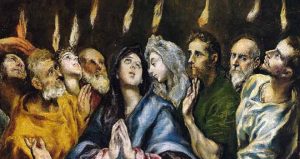
Pentecost raises the question for us: what are we looking for? What are expecting from God by the dynamic presence of his Spirit? Are nosotros, too, looking for something amazing?
This question takes three different forms, depending on where we are in our journey. For those relatively new to faith, y'all might simply be wondering what to await in this strange new world of conventionalities that you have discovered.
For those who have had expectations which take non been met, and take been living with disappointed, you might be agape of expecting anything more than. Perhaps yous accept prayed for something and the answer has non been forthcoming, or you have been living with a situation in which yous longed for God to intervene. Information technology has been said 'Wait cypher from anyone, and yous won't be disappointed.' Simply if you take that approach, your relationships will wither and die—and the same is truthful for our human relationship with God.
Only for those of united states who have been Christians for many years, nosotros might accept merely settled for a humdrum, routine kind of faith, with our expectations settling to a kind of manageable low. After all, it isn't possible to sustain the excitement and free energy through the race of life, which is a marathon not a sprint!
How do the accounts of the Spirit in Luke and Acts help shape our expectation? What are we looking for?
 Something normal
For many of the states, when nosotros first encounter the activity of the Spirit, it seems like something weird! I call back very clearly when I was in State of israel in my gap year, and staying in Jerusalem with some Americans, who were praying for one of their number (about to requite out tracts to Orthodox Jews at the Western Wall!) by laying on easily and praying in tongues. Information technology all looked pretty weird! At that place is currently a video being circulated on social media of Christian leaders praying for Donald Trump—by atheists who are pointing out how weird Christians are! Last calendar week in the centre of Archbishops' Council, I was in chat with someone nearly unlike traditions in the Church, and 'charismatics' were mentioned. 'Yes, they are a bit weird' was the response. 'Well, I am 1 of them'. 'Really? What's that all virtually so?'
Very often those of employ familiar with the activeness of the Spirit forget how weird it looks—or even say to others 'Yes, it is weird—come and be weird with u.s.a.!' But Peter's strategy at Pentecost in Acts 2 is just the opposite. The visitors to Jerusalem recollect the whole thing is weird—weird that in that location are tongues of burn down, weird that there is the audio of rushing wind, weird that they hear God praised in their dissimilar languages, and weird the things they are saying near Jesus.
But Peter's response is just the reverse. He counters the claims of weirdness—or drunkenness, 'It's only ix o'clock in the morning'—and instead argues that this is total normal and just what they should accept expected in the large narrative of God's dealings with his people. 'This is that about which the prophet Joel spoke'. If they had read their Bibles, they should not be surprised.
This is the consistent arroyo of the New Testament writers. The apparently weird manifestations of the Spirit are in fact office and parcel of the normal Christian life. Luke in item has set u.s. upwards with this expectation. John the Baptist preaches his 'good news' that the one coming afterwards him 'will baptise yous with the Holy Spirit and burn' (Luke 3.16)—and part of his 'good news' is that this person will come in judgement to burn the chaff! When Jesus appears, he is 'full of the Holy Spirit' (Luke 4.1) who leads him (or 'throws him' in Mark ane.12) into the desert, and after the fasting and temptations he is now 'in the power of the Holy Spirit' (Luke four.xiv)—which ways his ministry building can brainstorm. Even after the resurrection, when he spends 40 days with the disciples teaching them about the kingdom, he does so 'through the Holy Spirit' (Acts 1.two). If Jesus could not teach or heal or minister without the power of the Holy Spirit, neither can we!
The shut association between the Spirit and Jesus runs all the way through Paul'due south theology, and so that 'no one tin say, "Jesus is Lord," except by the Holy Spirit' (1 Cor 12.ane). If you are a follower of Jesus, then y'all must receive the presence of the Spirit—the two cannot be separated. Any Jesus now wants to do, he does by sending the Spirit on his people to exercise his will. (This is, of class, i reflection of our understanding of God equally Trinity; the 3 persons will and act together.)
The activity of the Spirit in our lives is something we should expect as a normal part of Christian discipleship.
 Something loving
Luke includes Jesus' teaching about prayer with a particular focus on the Holy Spirit in Luke 11. Following his business relationship of a version of the Lord's Prayer slightly abbreviated compared with Matthew, he and then records Jesus telling two parables near asking and receiving around a central proverb of assurance (Luke 11.5–13). We might at starting time not notice, but the theme that holds the parables together is that of loving relationship.
In the start scene, Jesus is painting a picture that his hearers would immediately recognise equally commonplace, and it has all the hallmarks of start century Eastern culture. It might be odd for u.s.a. to have someone arrive at midnight, since nosotros are happy to travel in the solar day. But in hot countries, people travel in the cool of the evening, and then would often arrive late. Nosotros have the option of offer hospitality, but in a culture where hospitality is prized, the only question you ask is 'How long would you like to stay?' Doors in the aboriginal earth would usually be shut with a unproblematic bolt mechanism (the text does not actually say 'locked' equally many English translations). And the scene is a one-room home, where all slumber together, so if the man gets upwards, everyone else volition be woken.
But what we hands miss is the language of friendship. The 3 people here are not simply neighbours, or acquaintances, they arephiloi, people who care about one another. The word is related to one of the two words for 'love' in the New Attestation,phileo. This episode is not one of mere practical concern; one person who cares about another asks a third whether they too care. Will the homo'southward friend assistance him in existence a good friend to his friend? It reminds us that the gift of the Spirit is a sign of the love of God for us that nosotros might be shaped by that honey then nosotros can express that love to others.
This is further emphasised in the second parable, illustrating that, evil though we are, those of us who are fathers know something of what it is to care for our children. The near challenging verse in the Bible for any begetter, and probably for whatever parent, is Ps 103.13: 'As a father has compassion on his children, then the Lord has compassion on those who fright him.' I know information technology is supposed to reassure me virtually the dear of God, just information technology besides reminds me of the challenge of fatherhood—that my beloved should in some small fashion reflect the beloved of God for his people.
The hardest thing for any parent is seeing your children suffer and experience hardship. When your children cry or are in distress, it is excruciating, not least because you know you cannot live their lives for them. And you don't have to be a parent yourself to understand this. The terrible case of Mark van Dongen was in the news this calendar week, when hisgirlfriend was bedevilled of throwing acid over him that crusade him such hurting and suffering that he ended his life. His brother reported 'My male parent used to be a big man—merely now he is totally broken'. 'As a begetter has pity on his children, so the Lord has compassion on those who fear him.'
In his sermon at the Imperial Wedding between Harry and Meghan, Michael Back-scratch preached 'The power of honey; when you're loved and you know it. When someone cares for you and you lot know it. When you love and you show it…' And Paul tells u.s.a. that we know the power of God'south love when nosotros know the presence of God'south Spirit (Rom v.5).
 Something nosotros need
Discover the motivation for the request in the first of Jesus' ii parables: a friend has come to stay, and the host does not have what is required to meet the person's need, and then he goes to the one who care for him, and who has what is required in lodge to supply his demand that he might the need of the other. That is exactly our state of affairs as we pray for the Spirit of God.
It is no accident that Luke puts this teaching adjacent to Jesus' didactics about the prayer for the kingdom to come. We do not have what we need, in our own strength, to run into God's name being honoured, to see his will being done, to meet his kingdom come up. Nosotros must therefore pray that God gives our 'daily bread', not simply our material demand, only besides the 'staff of life of tomorrow', the staff of life of the kingdom, the age to come, that we might bring this to others.
Two months ago I pulled something in my back, and last week I visited a chiropractor. He explained to me that our bodies are antalgic—they bend away from pain—and in my case information technology meant that my pelvis had turned and twisted away from the hurting on my left side so much that my right leg was now in effect 3/4 shorter than my left. No wonder I had been walking with a limp! Simply that is how many of usa are. We know the pain of disappointment, of cleaved relationships, of friends who have injure u.s.a. or let us downward, of life that has not met our expectations—and our lives are put out of shape equally we 'bend away from pain'.
The loving souvenir of the Spirit of God wants to straighten our lives again—past bringing both healing to our pain, and backbone as we look of the solar day of healing which is still to come up. Even if we do not run across full healing now (sometimes nosotros will, sometimes we won't), he gives us the hope of that Day of Healing when 'God will wipe every tear from our eye' (Rev 21.iv) and start to bring the reality of that 24-hour interval into the present.
Because this is something normal in the Christian life, because the Spirit is a gift of live, and because we need the gifts, power and fruit of the Spirit to meet our ain need and the needs of those around united states of america, Jesus urges us to be expectant—to pray with 'shameless audacity' (Luke xi.eight), whether we are new, disappointed, or simply a lilliputian jaded.
So I say to you: Inquire and it will be given to you; seek and you lot volition find; knock and the door volition be opened to you. For everyone who asks receives; those who seek find; and to those who knock, the door will be opened (Luke 11.9–10)
(This is a summary of a sermon preached at St Mary's Longfleet on Pentecost Sun, 20th May 2018.)
Follow me on Twitter @psephizo.Like my page on Facebook.
Much of my work is done on a freelance ground. If you have valued this post, would you considerdonating £i.20 a calendar month to back up the production of this weblog?
If yous enjoyed this, do share it on social media (Facebook or Twitter) using the buttons on the left. Follow me on Twitter @psephizo. Like my folio on Facebook.
Much of my piece of work is done on a freelance basis. If you lot have valued this mail, you can make a single or echo donation through PayPal:
Comments policy: Good comments that engage with the content of the post, and share in respectful fence, tin can add real value. Seek beginning to understand, then to be understood. Make the almost charitable construal of the views of others and seek to learn from their perspectives. Don't view debate as a disharmonize to win; address the argument rather than tackling the person.
Source: https://www.psephizo.com/life-ministry/what-should-we-expect-from-god-during-pentecost/
0 Response to "What should we expect from God during Pentecost?"
Post a Comment